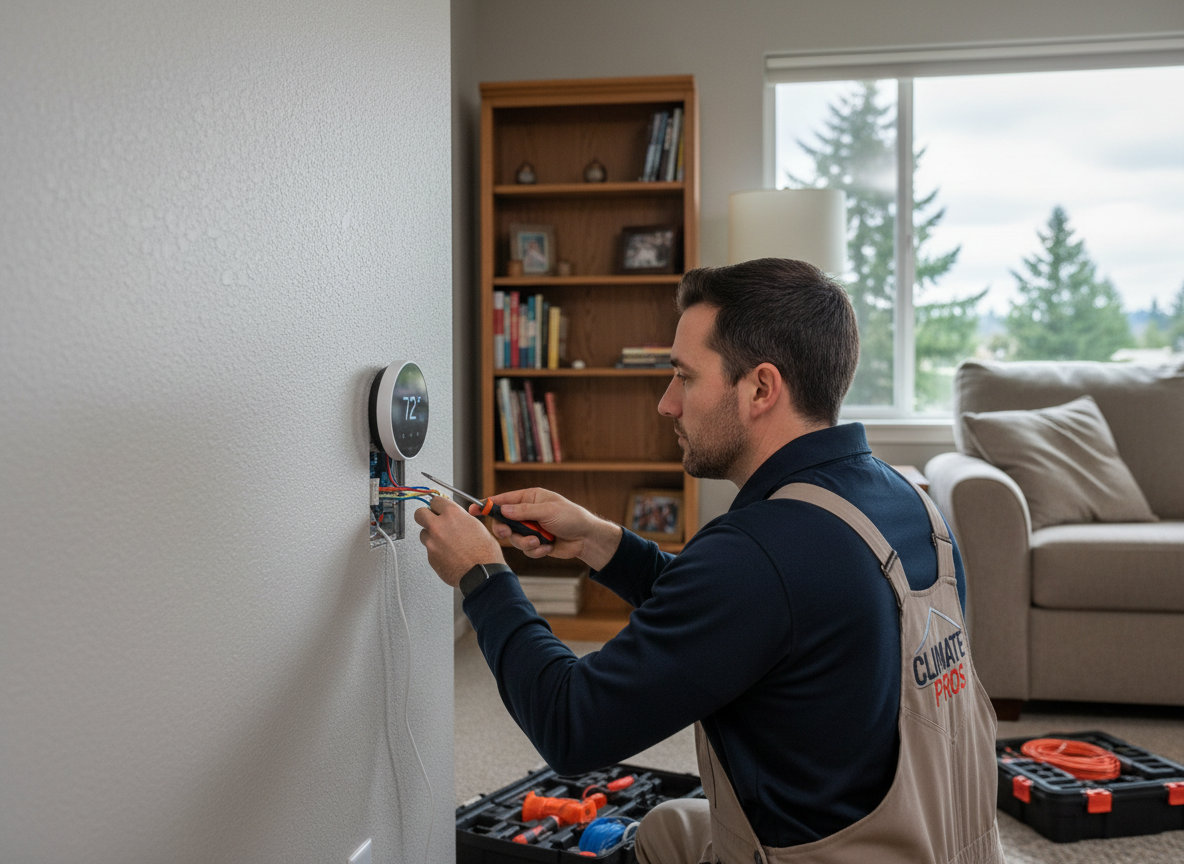
Milwaukie homes in neighborhoods like Ardenwald and Hector Campbell often date to the 1950s through 1970s, meaning many still run on 2-wire or 3-wire systems that lack a common wire. Installing a smart thermostat here frequently requires adding a C-wire adapter or running new low-voltage cable through finished walls without disturbing plaster or lathe. The county's mild wet winters drive constant heating demand from November through March, so any thermostat that loses power during a storm can leave residents without heat until the issue is fixed.
Downtown Milwaukie and Island Station properties sit close to the Willamette River, where higher humidity levels in shoulder seasons can cause condensation inside wall cavities and affect low-voltage connections over time. Technicians routinely check for proper wire insulation and secure terminations at the furnace or air handler to prevent future corrosion. Warm dry summers reduce cooling loads but increase the value of scheduling features that pre-cool before peak afternoon heat arrives from Portland.
Clackamas County building codes require that any new control wiring meet current low-voltage standards, and older homes near Milwaukie Museum often need an inspection when adding transformers or adapters. Edge cases include heat pumps with reversing valves that demand precise O/B terminal configuration and multi-stage systems common in larger Ardenwald properties. Always verify compatibility with the existing furnace or heat pump before ordering the thermostat to avoid return trips.
Battery backup models are preferred in areas with frequent power flickers during winter storms. Placement matters too: avoid exterior walls or direct sun from south-facing windows that skew temperature readings in summer.
Technician insight
In Milwaukie, the thing that catches most people out with smart thermostat installation is the lack of a C-wire in pre-1980 homes throughout Hector Campbell and Island Station. Those two-wire systems force us to add an adapter or pull new cable through finished walls, and the extra step always surprises homeowners who bought the thermostat online without checking their furnace wiring first.
Ardenwald Heat Pump Upgrade
A 1962 Ardenwald home had a two-stage heat pump with no common wire at the thermostat. We confirmed the reversing valve wiring and added a C-wire adapter inside the air handler rather than fishing cable through plaster. After connecting the new unit and setting up the app schedules, the system maintained even temperatures through a wet winter stretch without any power-related dropouts.
How it works
- 1
Site Assessment
Check existing wiring, furnace or heat pump type, and Wi-Fi signal strength at the thermostat location in the home.
- 2
Compatibility Check
Confirm the smart model works with the system's stage count and whether a C-wire adapter or new cable is required.
- 3
Wire Preparation
Run or adapt low-voltage wiring, label terminals, and secure connections at both the thermostat and equipment ends.
- 4
Installation and Setup
Mount the new thermostat, connect to the app, program schedules, and test heating, cooling, and fan modes.
- 5
Final Verification
Confirm proper operation through a full cycle and show the homeowner basic app functions and alerts.
Pricing
Most smart thermostat jobs in Milwaukie fall into a mid-range cost depending on whether new wiring or adapters are needed.